
Hair transplant in the US or Turkey: what the numbers actually say
US clinics median $21,000 for 3,000 grafts. Turkey’s median is $2,793. And 2/3 of American clinics won’t quote you a price at all before you sit down.
On this page · 10 sections
Summary
You already pay for this privately, so that is not the difference. The difference is that most US clinics will not tell you a price until you are in the chair versus the friendliness and luxury of a hair transplant in Turkey.
The median published US price for 3,000 grafts is $21,000, with the middle of the market running from $14,750 to $30,000. The median in Turkey for the same 3,000 grafts is $2,793. Both figures come from the same November 2026 study, which reads prices off clinic websites and standardizes them to the same case size.
But the number is not the most interesting thing in that data. Of 43 US clinics in the study's directory, only 14 publish any price at all. The other 29 quote at consultation. You are already paying for this out of pocket, so that is not what makes the American market different. What makes it different is that you cannot find out what it costs before you are sitting in the chair.
How much does a hair transplant cost in the US?
Published US prices run from a median of $9,500 for 1,000 grafts to $40,000 for 5,000 grafts, and the spread inside each of those is wide enough to matter more than the median does.
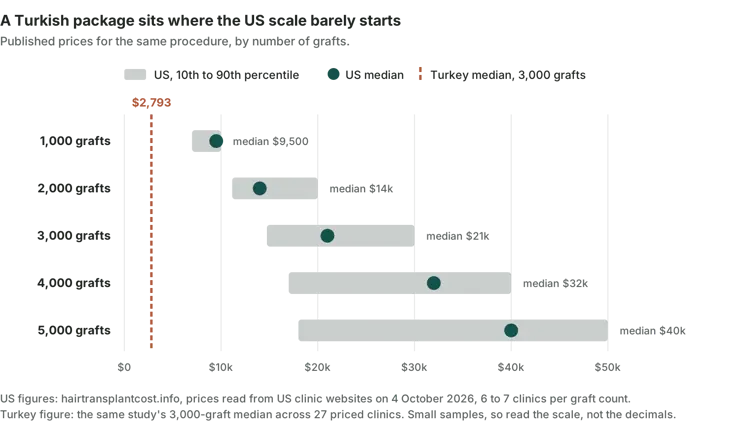
Grafts | US median | 10th to 90th percentile | Clinics publishing |
|---|---|---|---|
1,000 | $9,500 | $7,000 to $10,000 | 6 |
1,500 | $12,000 | $9,550 to $15,000 | 6 |
2,000 | $14,000 | $11,150 to $20,000 | 7 |
2,500 | $17,500 | $13,900 to $25,000 | 7 |
3,000 | $21,000 | $14,750 to $30,000 | 7 |
4,000 | $32,000 | $17,000 to $40,000 | 6 |
5,000 | $40,000 | $18,000 to $50,000 | 6 |
Scroll sideways for all columns →
hairtransplantcost.info, prices read from US clinic websites on October 4, 2026. The last column is the whole sample, not a market survey, which is the point of the next section.
Named per-graft rates in that data give you the real range: Limmer in San Antonio at $5.50 per graft for large strip sessions and $7 for large FUE, ForHair in Atlanta at $8 to $12, Parsa Mohebi in Los Angeles at $10 with an associate surgeon and $16 with the founder, and Northwestern Hair in Chicago from $7 up to $28 depending on technique. Physician's Hair Institute in Arizona publishes a rate that falls from $7 to $3.50 per graft as the session gets larger.
Why won't most US clinics tell you the price?
Twenty-nine of the 43 US clinics in that directory publish no price, and quote only after a consultation. That is two thirds of the market, and it is a structural difference rather than a coincidence.
A consultation-only quote is defensible on the medicine. Graft counts genuinely differ per person, nobody can set one from a photograph, and a surgeon who commits to a number before examining your scalp is guessing. But it also means you cannot compare before you commit time, and in several cases a deposit. A Turkish clinic that publishes a package price has taken a position you can hold it to. A US clinic that quotes at consultation has not.
That is the gap worth naming on this page, because it is the one American patients actually run into. Not that they are unused to paying privately, and not that they are unused to service. They are unused to shopping with the prices visible.
Why is the cheaper US option the one that leaves a scar?
Strip surgery is the cheaper American route, and the saving is paid for in scarring rather than in quality. In that same data, the median US price for 3,000 grafts by strip, also called FUT, is around $17,100 across four clinics. By FUE it is $28,500 across six. Strip removes a band of skin from the back of the head and closes it, leaving a linear scar; FUE takes follicles one at a time and leaves a field of small round marks.
So a US patient looking at a $17,000 quote and a $28,000 quote is usually not looking at two prices for the same thing. He is looking at a decision about what the back of his head will look like with short hair, priced about $11,000 apart. That is worth knowing before you treat the cheaper American number as your benchmark.
Turkish clinics work almost entirely in FUE and its variants, which is the like-for-like comparison with the $28,500 figure rather than with the $17,100 one. Our guide on FUE, DHI and sapphire FUE covers what separates them and what does not.
What does a hair transplant in Turkey cost, and what is in the price?
Turkish clinics sell all-inclusive packages, and for international patients those run from about $1,700 at the practical floor to around $4,500, with a luxury tier above that where there is more surgeon involvement and fewer patients scheduled per day. The study's median for 3,000 grafts is $2,793, or about $0.93 per graft against the US median of $9.00.
What sits inside a Turkish package and inside no US quote: two to three nights of hotel, airport and clinic transfers, a translator for the surgery day, pre-operative bloodwork, medication and an aftercare kit, the first wash, and some form of follow-up. You need none of that in Dallas, because you drive home. So the comparison is not one surgery against another surgery. It is a surgery against a trip.
Two figures you should leave out of your own math. Turkish clinics also sell to Turkish residents at around $900 to $1,700, and that price has no flight, no hotel and no interpreter in it. And clinics commonly offer a treatment at roughly $1,600 knowing an intermediary will resell it at around $2,700, a margin that buys you nothing clinically and adds a link between you and whoever is answerable if something goes wrong. Our guide to what an all-inclusive package actually includes sets out the three layers a quote has to cover before the number means anything.
Are Americans actually going to Turkey for this?
Yes, in numbers large enough that CBS News sent a reporter. In an August 2024 report by Megan Cerullo for CBS MoneyWatch, Istanbul surgeon Dr. Serkan Aygin said he performs about 20 hair transplants a day and that as many as eight of those patients are American. Turkey received 1.5 million medical tourists in 2023, spending roughly $3 billion.
The report follows Aaron Collins, 30, from Chicago, who paid $6,000 for about 4,100 grafts in Istanbul and put the saving at somewhere between a third and a fifth of the US price. "I really came here for the price," he told CBS. Aygin's clinic charges a flat 3,000 euros and Aygin himself estimates the equivalent US procedure at $25,000, which is a clinic's own estimate rather than an independent figure, but it sits inside the published US range for a large case.
The honest cost nobody puts in a package: the flight. New York to Istanbul is roughly ten hours in the air, not the three a European flies, and you will want four days on the ground. Add the airfare and the time off and the difference narrows, though at these numbers it does not close. What it does change is the aftercare question, because the whole first year happens at home: our month by month hair transplant timeline sets out when that actually matters.
Who actually performs the surgery?
Ask that question first, before price, and ask it in both countries. The International Society of Hair Restoration Surgery has been making this point since at least 2014, and in a 2016 media release warned that some patients are drawn in by a physician's credentials while a technician who is not licensed to perform surgery does the operation. Its recommendation then was simple and has not aged: confirm that a physician performs every stage, start to finish.
One part of that 2016 release is now out of date, and we would rather say so than quote it as current. It stated that Turkey's Health Ministry had restricted hair transplants to hospitals, making clinic procedures illegal. Turkey's framework today runs the other way: the Ministry of Health issues International Health Tourism Authorizations to clinics treating foreign patients, which is the licence HairLinQ checks and re-checks. Anyone citing the 2016 position as today's position is quoting a decade-old document.
What we verify is that authorization and nothing more, as our clinic verification methodology states. It is not a warranty of quality, safety, competence, pricing or results. We keep the list small and speak to each clinic by phone and video first, but that is a selection, not an inspection, and we do not follow patients after they book. If a listed clinic falls short of what it promised, the notice and complaints procedure is how to tell us.
Questions American patients ask
Does insurance cover a hair transplant?
Treat it as an out-of-pocket purchase. Hair transplants for pattern hair loss are handled as cosmetic surgery, and the published US clinic prices in this article are retail prices patients pay themselves. If your hair loss follows surgery, trauma or a medical condition, ask your insurer directly rather than relying on a general answer.
Is a hair transplant in Turkey really a fifth of the US price?
On medians, roughly. $2,793 against $21,000 for 3,000 grafts is about one eighth, and the US figure for FUT rather than FUE narrows that. Against a Turkish package, add your airfare and four days, and compare the Turkish number with the US FUE price rather than the strip price, because that is the same procedure.
How many grafts will I need?
Nobody can tell you from a photograph, and any website that gives you a number from one is guessing. It depends on your donor area, the area being treated and your age, and only a doctor who examines your scalp can judge it. Ask early, because the entire price comparison hangs on that number.
What should I ask before I pay a deposit?
Which stages the named surgeon personally performs, how many procedures that surgeon has scheduled on your date, the specific graft figure and what happens to the price if it changes on the day, the written revision policy with its time limit, and the cancellation terms. A clinic that answers all five without friction has told you a great deal.
What happens if the result disappoints?
Distance is the problem, not the country. Get the revision policy and the complaints process in writing before you fly, and establish who reviews your photographs at month three and month twelve. Our guide on what actually goes wrong with hair transplants in Turkey covers the warning signs and the routes open to you.
Before you decide
Everything above concerns prices, packages and what clinics publish. It is not medical advice, and it cannot tell you whether surgery suits you, how many grafts your case needs, or which technique fits your hair. Only a physician who examines your scalp can judge that, so have that conversation before you commit to a clinic or a date, at home or abroad. Our patient terms and medical disclaimer set out what that means for how you use this site.
Sources
- https://hairtransplantcost.info/blog/hair-transplant-cost-usa
- https://hairtransplantcost.info/blog/hair-transplant-cost-2026-data-study
- https://www.cbsnews.com/news/turkey-istanbul-hair-transplant-medical-tourism/
- https://plasticsurgerypractice.com/treatment-solutions/innovations/research/ishrs-warns-black-market-hair-restoration-services-medical-tourism/