
FUE, DHI and sapphire FUE in Turkey: what differs and what each costs
FUE, DHI and sapphire FUE compared on method, shaving and price. What each costs in Turkey in 2026, and why the technique barely moves the figure.
On this page · 12 sections
What are FUE, DHI and sapphire FUE?
FUE, DHI and sapphire FUE are three ways of performing the same operation: taking hair follicles from your donor area and putting them back where your hair is thinning. FUE describes how the follicles come out. DHI and sapphire FUE mostly describe how they go back in.
Turkish clinics advertise all three somewhere between €1,850 and €7,800 all-in, and the technique is not what moves you around inside that range. The Turkish clinics on our platform offer all three, and in the quotes we receive we see no consistent price difference between them for the same number of grafts. Which one a clinic proposes depends more on your donor area, the size of the area being treated, and whether your head is shaved.
Which gives you the honest answer to the question that brought you here: the technique is rarely the dial your result turns on, and it is rarely the dial your invoice turns on either.
What is an FUE hair transplant?
FUE stands for Follicular Unit Excision, and it underlies nearly every hair transplant performed in Turkey today. The surgeon removes follicles one at a time from the back and sides of your head using a small hollow punch, rather than cutting out a strip of skin as in the older strip technique. What remains is several hundred small round wounds that heal as dots.
One detail about that name tells you more than most of the internet does. The International Society of Hair Restoration Surgery changed the E in FUE from "Extraction" to "Excision" in March 2018, precisely because "extraction" makes it sound like something other than surgery. Board member Ricardo Mejia said at the time that "any attempt to downplay the significant surgical aspects of FUE to appear less invasive is misleading".
So it is surgery. With wounds, anaesthetic and a recovery period. That is not a reason to avoid it, but it is a reason to take the clinic performing it more seriously than the name of the technique.
What is DHI?
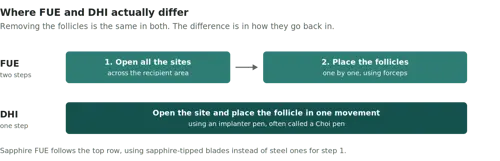
DHI stands for Direct Hair Implantation, and the difference lies entirely in the placement. In standard FUE the surgeon opens all the recipient sites first, then places the follicles with forceps. In DHI both happen in one movement using an implanter pen, often called a Choi pen: the pen opens the site and leaves the follicle in it.
The advantages clinics attribute to this, such as less time outside the body for the follicles or tighter control over the angle the hair grows at, sound plausible. Independent evidence turning them into a better final result is thin. Those who present it as settled are usually selling it.
What DHI does mean in practice: it is slower per follicle, so it is proposed less often for very large sessions, and it lends itself better to work where the head is not fully shaved.
What is sapphire FUE?
Sapphire FUE is ordinary FUE in which the recipient sites are opened with sapphire-tipped blades instead of steel ones. It is not a different operation, it is different tooling within the same operation. Clinics cite sharper, smaller incisions as the reason.
Worth knowing: sapphire says nothing about how the follicles are then placed. Sapphire blades can be combined with forceps placement or with an implanter pen, and some clinics sell that combination under a name of their own.
What is the difference between FUE and DHI?
The difference between FUE and DHI lies solely in how the follicles are placed, not in how they are removed.
Technique | What changes | Shaving | Price premium in quotes | What it means |
|---|---|---|---|---|
FUE (steel or sapphire) | Sites opened first, then placed with forceps | Usually full | None seen | Works fast, suits large sessions |
DHI | Site opened and follicle placed in one movement | More often partial or none | None seen | Slower per graft, more control over angle |
Sapphire FUE | Sapphire-tipped blades instead of steel | Usually full | None seen | Different tooling, not a different operation |
Scroll sideways for all columns →
Based on quotes HairLinQ received from partner clinics during 2026, plus the techniques those clinics publish. "None seen" means we find no structural price premium for a technique at the same graft count, not that one exists nowhere.
How much does FUE cost in Turkey compared with DHI?
Turkish clinics advertise FUE from around €1,850 to €5,850 all-in, DHI from around €2,200 to €5,850, and sapphire FUE from around €2,500 to €7,800, depending on which clinic's price list you read. Those are list prices for packages, which is not the same thing as the same case priced three ways.
Technique | Acibadem International | Globalmedik | What the gap between them tells you |
|---|---|---|---|
FUE | €2,600 to €5,850 | €1,850 to €3,000 | The two FUE ranges barely overlap, so neither is a market rate |
DHI | €3,000 to €5,850 | €2,200 to €3,500 | Both put DHI above FUE at the bottom end, not at the top |
Sapphire FUE | €3,000 to €7,800 | €2,500 to €4,500 | Sold as a premium tier, so the ceiling moves rather than the method |
Scroll sideways for all columns →
All-inclusive package prices as published by Acibadem International (September 2026) and Globalmedik (2026). Converted figures are theirs, not ours.
Look at the Acibadem figures closely and the pattern gives itself away. DHI starts €400 above FUE and finishes at exactly the same ceiling, €5,850. A technique that genuinely cost more per follicle would be dearer at every graft count, not only at the cheap end.
Here is what we think is actually happening, and it is the reason our own quote data and the public price lists can both be right. Advertised technique prices are package tiers rather than like-for-like comparisons. DHI is proposed more often for smaller sessions and for work where the head is not fully shaved, both of which carry their own pricing. Sapphire is positioned as the premium tier, so it inherits a higher ceiling by design. Line up the list prices and you see a premium. Price the same case at the same graft count, which is what a quote does, and it largely disappears.
Which means the technique is a poor lever for managing cost. Graft count and package contents move the figure far more, and both are covered in our guide to hair transplant cost per graft and our guide to what a hair transplant in Turkey costs.
Can you have a hair transplant without shaving your head?
Unshaven and partly unshaven hair transplants are offered by a growing number of Turkish clinics, although full shaving is still the default. Some clinics shave only the donor area at the back and leave the hair on top in place. Others will work an individual area, such as a receding hairline, without touching the rest.
 What it costs: in the quotes we see, clinics generally do not charge much extra for it. It is a way of working rather than a more expensive package. Whether it is possible for you depends on your hair, your scalp and the number of grafts needed, and the clinic assesses that at consultation.
Ask about it explicitly if you need to be visible at work soon afterwards, because it is not a standard option everywhere. It also changes what your journey home looks like, which we cover in our guide on what to expect on a hair transplant trip to Turkey.
Why almost every comparison you find is written by a seller
Comparisons between FUE and DHI are published almost entirely by parties that sell one of them. We went through the twenty most findable English-language pages on this question. Not one was independent. They were clinics and medical tourism agencies, and nearly every page concluded in favour of the technique its author happens to offer.
Globalmedik's price guide is a workable example, and we are picking on it only because it is typical. The page states that DHI is typically 20 to 40 percent more expensive than standard FUE, while the midpoints of its own table put the gap at roughly 18 percent. The same page gives the overall cost of a Turkish hair transplant as €1,500 to €6,000 near the top and €2,000 to €5,000 near the bottom. Nobody checked, because the numbers are there to frame a decision rather than to be checked.
That does not automatically make such pages wrong, but it explains why you find two opposite answers to the same question. When you read a comparison, check who publishes it and what they sell before you read the argument. It is faster than reading the argument.
What do Sapphire DHI, Micro FUE and Soft FUE mean?
Names such as Sapphire DHI, Micro FUE, Soft FUE and Mega FUE are trade names rather than separate surgical categories. A clinic or clinic group puts its own label on its particular combination of tooling and working method, which makes two clinics doing much the same thing look as though they offer something different.
The clinics on our platform use the ordinary terms: FUE, DHI, sapphire FUE. We keep that consistent in quotes and on clinic profiles, so you can look up what is being proposed without decoding a brand name first.
What patients actually ask us about technique
Patients almost never ask us for a specific technique. What we see in requests is the same three things: here is the result I have in mind, here is what I want to know about cost, and tell me which treatment fits that best. They know they are not the expert and they ask for advice.
That strikes us as the most sensible position to take in this market. So do not ask a clinic whether they do DHI. Ask what they propose for your situation, why, and what it costs.
What we check about a clinic is that it holds a valid Turkish government authorisation for international health tourism, and nothing about surgical skill or outcome. How that works is set out in our clinic verification methodology, which is not a warranty of quality, safety or results.
If you want to see what clinics propose for your situation, you can request up to six quotes in one go and compare the proposals side by side.
Questions patients ask about FUE, DHI and sapphire FUE
Is DHI better than FUE?
DHI is not demonstrably better than FUE. Both use the same method of removing follicles and differ only in how those follicles are placed. Independent evidence that one produces a better final result than the other is scarce, and the parties asserting it usually sell it. The skill and working method of the team performing the surgery weigh more heavily than the choice between these two.
Which technique is cheapest?
No one technique is structurally cheaper at Turkish clinics. Published price lists put DHI and sapphire above FUE at the bottom of their ranges, but in the quotes we receive we see no consistent price difference at the same graft count. Price is driven far more by the number of grafts and by what the package includes, such as hotel, transfers and aftercare.
Why do clinic price lists show DHI as more expensive then?
Published technique prices are package tiers rather than the same case priced twice. DHI is proposed more often for smaller sessions and for partly unshaven work, and sapphire is positioned as a premium tier with a higher ceiling. Acibadem International's own figures illustrate it: DHI starts €400 above FUE and finishes at the identical ceiling of €5,850.
Can a hair transplant be done without shaving?
A hair transplant without full shaving is possible at a growing number of Turkish clinics, sometimes for part of the head only. Whether it works in your case depends on your hair, your scalp and the number of grafts, which the clinic assesses at consultation. Ask in advance, because not every clinic offers it.
Do I need to choose a technique before requesting a quote?
No, choosing a technique before requesting a quote is unnecessary. Describe what you want to achieve and let the clinic propose what fits and explain why. That also makes the proposals easier to compare than asking everyone for the same technique.
Before you decide
This article explains in general terms how these techniques work, and it is not medical advice. What is possible and sensible for you depends on your hair loss, your donor area and your health, and only a doctor who actually examines your scalp can judge that. Speak to a qualified doctor or arrange a clinic consultation before you commit. Our full terms are set out in the patient terms and medical disclaimer.
Prices checked against published guides from Acibadem International and Globalmedik, November 2026. Technique definitions checked against the International Society of Hair Restoration Surgery. Last checked 6 November 2026.