
Is a Hair Transplant in Turkey Safe?
HairLinQ Editorial
Researched in Istanbul and Amsterdam.
Sources checked against the American Society of Plastic Surgeons and ISHRS guidance / 02 Oct 2026. How we research
Is a Hair Transplant in Turkey Safe?
A hair transplant in Turkey is generally safe when it is carried out by qualified people in a licensed facility, and the danger sits almost entirely in whether that is true of the clinic you pick rather than in the country itself. Serious harm is rare: six hair transplant deaths have been reported worldwide since 2016, and two of them were in Turkey.
That is the honest headline, and it is neither the reassurance a clinic would give you nor the warning a competitor would. What follows is the detail: what the reported cases involved, what the recognised risks are, what is normal after surgery and what is not, and the checks that remove most of the danger before you pay anything.
HairLinQ is paid by the clinics on our platform. We have written this page to be useful to someone who decides not to travel at all, because a safety page that only ever concludes "go ahead" is an advert.
How dangerous is a hair transplant?
Death from a hair transplant is very rare. Six cases have been reported worldwide since 2016, according to a review by the Wimpole Clinic citing the International Society of Hair Restoration Surgery and the British Association of Hair Restoration Surgery. Over the same period, ISHRS members alone performed more than 2.5 million procedures.
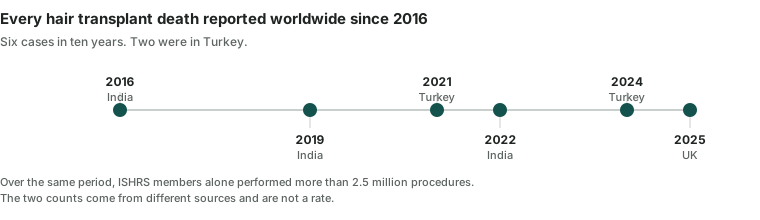
Year | Where | Reported cause |
|---|---|---|
2016 | India | Procedure carried out by unqualified practitioners |
2019 | India | Severe allergic reaction; the patient had requested 9,000 grafts |
2021 | Turkey | Reported as cardiac; the cause was disputed and a doctor was arrested |
2022 | India | Sepsis following infection, leading to organ failure |
2024 | Turkey | Death following severe psychological distress after a poor result |
2025 | United Kingdom | Unexpected illness before the procedure |
Cases as reported by the Wimpole Clinic, September 2026. We are not naming clinics because several of these cases are contested.
Two things stand out. The first is that the United Kingdom appears on this list, which is worth remembering when you read that travelling abroad is inherently reckless. The second is that most of these cases trace back to something identifiable: an unqualified person operating, a facility without proper screening, an infection that went untreated. Those are failures of the clinic, not of the procedure.
The 2024 case is a reminder that the psychological side of this is real. A result that disappoints can affect people badly, particularly when expectations were set by marketing rather than by a doctor. If you are struggling with how you feel about your hair or about a result, that is worth talking to your own doctor about, not just a clinic.
What are the actual risks of a hair transplant?
The American Society of Plastic Surgeons lists the recognised complications of hair transplantation as infection, excessive bleeding, wide or stretched scarring, grafts that fail to take, small bumps at the transplant sites, and a patchy appearance if hair loss continues after surgery.
The ASPS also states that the surgery is normally safe when performed by a qualified, experienced surgeon, while noting that results are never completely predictable because people heal differently.
Two risks specific to a high-volume market deserve naming alongside those. Overharvesting of the donor area, where too many follicles are taken, can leave permanent visible thinning at the back and sides and removes your options for a second procedure later. And an unnatural hairline, wrong in angle, density or shape, is difficult and expensive to correct.
What is normal after a hair transplant, and what is not?
Normal healing after a hair transplant includes swelling, redness, small scabs and a phase where the transplanted hair falls out before regrowing. The signs worth acting on are the ones that suggest infection or damage rather than healing.
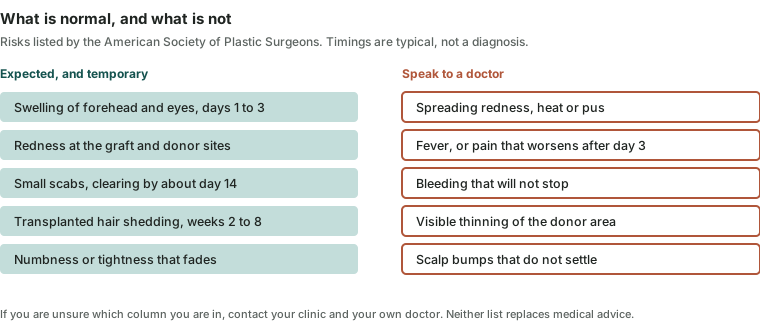
Expected and temporary | Speak to a doctor |
|---|---|
Swelling of forehead and eyes, days 1 to 3 | Spreading redness, heat or pus |
Redness at the graft and donor sites | Fever, or pain worsening after day 3 |
Small scabs, clearing by about day 14 | Bleeding that will not stop |
Transplanted hair shedding, weeks 2 to 8 | Visible thinning of the donor area |
Numbness or tightness that fades | Scalp bumps that do not settle |
Complications listed by the American Society of Plastic Surgeons. Timings are typical rather than universal, and this table is general information, not a diagnosis.
The shedding phase catches most people out. Transplanted hair commonly falls out a few weeks after surgery before the follicle regrows, and it can look exactly like failure while being entirely normal. Your clinic should have told you this before you flew. If it did not, that is worth noting about the clinic.
Is Turkey more dangerous than having a hair transplant at home?
Turkey is not inherently more dangerous, and the variation between clinics inside Istanbul is wider than the variation between Istanbul and Berlin. What differs is not the average standard but the range, and what happens when something goes wrong.
Three differences are real and worth weighing:
Follow-up is remote. If something looks wrong in week three, you are messaging a clinic in another country rather than walking into one. Your own doctor may decline to manage a cosmetic procedure carried out abroad.
Recourse is harder. A complaint against a Turkish clinic runs through Turkish processes, in Turkish, at a distance.
The market is enormous, so the bottom of it is enormous too. Istanbul has thousands of clinics, and the International Society of Hair Restoration Surgery has warned publicly about unlicensed practitioners operating in what it calls black market clinics. The Turkish Health Ministry has acknowledged how difficult enforcement is at that scale.
Against that, Turkey requires any clinic treating international patients to hold a Ministry of Health International Health Tourism Authorization, which is audited rather than self-declared. The framework exists. It does not enforce itself, and nobody checks it for you unless you ask.
What makes a Turkish hair transplant clinic unsafe?
This is not just for Turkish hair transplant clinics, but for clinics all around the world. An unsafe clinic is usually identifiable before you book, and the warning signs are commercial rather than medical. The pattern behind reported cases is consistent: nobody checked who was operating, in what kind of facility, on how many patients that day.
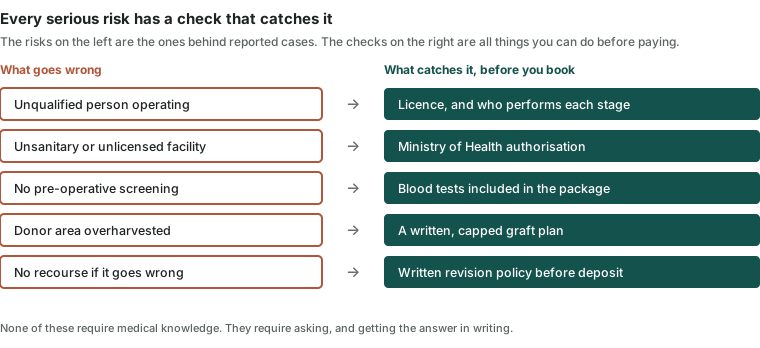
What goes wrong | What catches it, before you book |
|---|---|
Unqualified person operating | The licence, and who performs each stage in writing |
Unsanitary or unlicensed facility | Ministry of Health authorisation, checked by certificate number |
No pre-operative screening | Blood tests included in the package |
Donor area overharvested | A written, capped graft plan rather than "unlimited grafts" |
No recourse if it goes wrong | A written revision policy agreed before any deposit |
Our guide to choosing a hair transplant clinic in Turkey covers each of these checks in detail, including how to verify an authorisation certificate.
The single most useful question, and the one a website almost never answers: which stages does the named surgeon personally perform, and how many procedures is that surgeon scheduled for on your date? A clinic running three operations at once cannot give any of them a surgeon's full attention, whatever its marketing says.
What does HairLinQ check, and what does it not?
HairLinQ confirms that a clinic holds a valid Turkish Ministry of Health International Health Tourism Authorization, and re-checks it. That is a licensing check and nothing more. It removes a category of operator, and it is the first of the checks above rather than all of them.
We do not assess surgical skill, audit outcomes, or guarantee that a clinic honours its quote. Accreditations such as JCI, TEMOS or ISHRS membership are declared by clinics and are not verified by us. Our clinic verification methodology states plainly that verification is not a warranty of quality, safety, competence, pricing or results.
Nobody can tell you from a webpage whether surgery is safe for you specifically. That depends on your health, your medication and your scalp, and it needs a doctor who has examined you.
Questions patients ask about safety
Has anyone died from a hair transplant in Turkey?
Two of the six hair transplant deaths reported worldwide since 2016 occurred in Turkey, one in 2021 where the reported cardiac cause was disputed, and one in 2024 following severe psychological distress after a poor result. Deaths from this procedure are rare anywhere.
What is the most common complication of a hair transplant?
The American Society of Plastic Surgeons lists infection, excessive bleeding, wide scarring, grafts failing to take, small bumps at transplant sites, and a patchy look if hair loss continues. Most are treatable; donor area overharvesting and a badly designed hairline are the hardest to correct.
Is it normal for transplanted hair to fall out?
Yes. Transplanted hair commonly sheds a few weeks after surgery before the follicle regrows, which is expected rather than a sign of failure. A clinic that did not warn you about this before you travelled told you something about itself.
Are cheap Turkish clinics dangerous?
Price alone is a weak signal, but below roughly €1,500 all-in something is being cut, and the usual candidates are procedure length, who performs it and how many patients share the surgeon that day. Ask those questions directly rather than judging by the number.
What should I do if something looks wrong after I get home?
Contact your clinic immediately, and contact a doctor where you live in parallel rather than waiting for the clinic to reply. For signs of infection such as spreading redness, heat, pus or fever, seek medical advice locally the same day.
Before you decide
Everything above is general information about how this market works and what published sources report, not medical advice, as set out in our patient terms and medical disclaimer. It cannot tell you whether surgery is safe in your case, how your medication or health history affects that, or what result is realistic for you. A qualified doctor who has examined you can, and that conversation is worth having before you book flights rather than after.