
The hair transplant timeline: what the first year actually looks like
Bandages off in 2 to 5 days, shedding by week 6, new hair from month 4. What the first year after a hair transplant really looks like, with named sources.
On this page · 8 sections
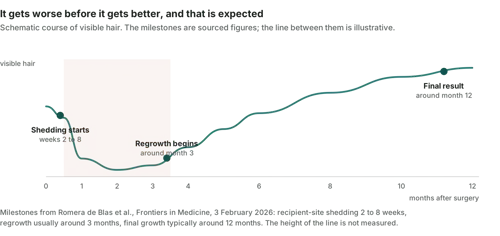
A hair transplant looks worse before it looks better, and the dip is the part nobody photographs. The NHS sets out the course like this: bandages come off after 2 to 5 days, you can gently wash your hair by hand from day 6, non-dissolvable stitches come out at 10 to 14 days, the transplanted hair falls out within a few weeks, new hair usually begins to appear from around 4 months, and the full result is visible somewhere between 10 and 18 months.
Which means that at week 6 you will have less visible hair than you did on the flight home. That is the expected course, not a failed procedure. Below is the whole first year with dates, the places where the published sources disagree, and the one arrangement worth settling before you pay a deposit.
Stage | When | What happens | Source |
|---|---|---|---|
Swelling peaks | Days 2 to 3, gone by 5 to 7 | Forehead and around the eyes | Frontiers in Medicine |
Bandages off | Days 2 to 5 | Do not touch the grafts | NHS |
Crusts form and clear | Form days 2 to 3, gone by 7 to 10 | Crusting past 2 weeks needs looking at | Frontiers in Medicine |
First gentle wash | Day 6 | By hand only | NHS |
Stitches out | Days 10 to 14 | Only if non-dissolvable stitches were used | NHS |
Back at work | After 1 to 2 weeks | Grafts are fragile for the first 2 weeks | NHS |
Transplanted hair sheds | Weeks 2 to 8 | The hair falls, the follicle stays | Frontiers in Medicine |
Donor area sheds | From weeks 2 to 4, settles by months 3 to 6 | The back and sides thin temporarily too | Frontiers in Medicine |
Redness fades | Weeks 2 to 4 | Redness past 4 weeks is not normal | Frontiers in Medicine |
Exercise again | After the first month | Cutting back early reduces scarring | NHS |
New hair appears | Month 3 to 4 | Fine and pale at first | Frontiers in Medicine, NHS |
Poor growth becomes visible | Months 6 to 12 | Earlier than this there is not enough to judge | Frontiers in Medicine |
Full result | Month 12 to 18 | The sources disagree, see below | Frontiers in Medicine, NHS |
Scroll sideways for all columns →
Figures as published in November 2026. NHS guidance on hair transplants, and Romera de Blas et al., "Complications in follicular unit excision hair transplantation", Frontiers in Medicine, 3 February 2026.
What happens in the first two weeks after a hair transplant?
The first two weeks are the only stretch that needs genuine care, and the NHS is blunt about why: the grafts are not secure yet, so you have to be very careful with the transplanted hair for the full fortnight. Swelling across the forehead peaks at two to three days and is usually gone by day seven. The crusts form at the same time and clear between days seven and ten.
Most men are back at work after one to two weeks, which is the NHS figure, though that assumes nobody at work is studying your hairline.
Here is the part worth noticing about the Turkish route specifically. Of those two weeks, roughly four days happen in Turkey. Everything after that happens in your own bathroom. That is not a problem, because the care in that window is washing technique and sleeping position rather than anything clinical. But it does mean the clinic that performed the surgery is not the one looking at your scalp on day nine, and that is worth arranging rather than assuming. Our guide to what a hair transplant trip to Turkey involves covers the four days themselves.
Why does transplanted hair fall out after a few weeks?
Transplanted hair sheds because the follicle goes dormant after being moved, and the hair shaft it was holding is released. The follicle stays where the surgeon put it. According to the Frontiers in Medicine review, this shedding around the recipient area happens between two and eight weeks after surgery. The American Society of Plastic Surgeons describes it as almost always temporary.
Two other things shed at the same time, and they get confused with each other constantly.
The donor area. The back and sides thin too, starting at two to four weeks and settling between three and six months, per the same review. Nobody warns you about this one.
Your existing hair around the grafts. This is shock loss proper, and it is a complication rather than part of the plan. The Frontiers review reports an incidence anywhere from 0.15% to 15%, a spread wide enough to tell you the data is poor, and names female sex as a major risk factor.
When does new hair start to grow after a hair transplant?
New hair starts somewhere between month three and month four, and the two main sources sit a month apart on it. The Frontiers in Medicine review puts regrowth at around three months. The NHS says new hair usually begins to appear from around four months. Neither is wrong; it is a range, not a date.
What appears first is not the hair you are expecting. It comes through fine, pale and sparse, and it thickens over the following months. The American Society of Plastic Surgeons puts growth at roughly 1.3 cm a month once it resumes, which is ordinary hair growth, so the maths from month four onwards is just time.
Is the full result at 12 months or 18 months?
The full result lands between 10 and 18 months according to the NHS, and at around 12 months according to the Frontiers in Medicine review. Clinic aftercare pages almost all say 12. That gap matters, because 12 months is the optimistic end of the official range and it is the number most patients end up judging themselves against.
Source | Full result at | What kind of source this is |
|---|---|---|
NHS | 10 to 18 months | UK national health service, public patient guidance |
Frontiers in Medicine, 2026 | Around 12 months | Peer-reviewed review of FUE complications |
Clinic aftercare pages | Commonly 12 months | Clinic's own marketing, no source given |
Scroll sideways for all columns →
We read six clinic aftercare pages in November 2026 for the bottom row. Two of them gave two different final-result timings on the same page.
So if you reach month 12 and your hair is thinner than the gallery photograph that sold you the procedure, you are inside the NHS range with six months still to run. Density keeps building after the first year. That is not a consolation, it is the published timeline.
What if there is no growth at four months?
Four months is where growth starts, not where you measure it. The NHS gives month four as the point new hair usually begins to appear, and the Frontiers in Medicine review notes that poor growth only becomes apparent between six and twelve months. At month four there is genuinely not enough information to tell a slow start from a bad outcome.
That is an unsatisfying answer when you are the one staring at the mirror, so here is the useful version: month four is when you should be sending photographs to the surgeon who operated on you, not when you should be drawing conclusions from them. Whether that person will look at them is a question you want answered before you book, which brings us to the next part. If something has clearly gone wrong rather than slowly, our guide on what actually goes wrong with hair transplants in Turkey covers the warning signs and the routes to complain.
Who checks your result when your surgeon is in another country?
Your operating doctor is meant to, and four medical associations said so jointly. In December 2023 the British Association of Hair Restoration Surgery, the British Association of Aesthetic Plastic Surgeons, BAPRAS and the Turkish Society of Plastic, Reconstructive and Aesthetic Surgeons issued minimum guidelines for UK patients having hair transplants in Turkey. Four of their points are about the period after you fly home:
The operating doctor should assess your interim progress and your final result, not a coordinator and not a chatbot.
The clinic should be able to handle complications during and outside working hours, including assessing infection, cysts, skin necrosis and nerve pain, and providing antibiotics.
There should be a clear complaints process you can actually use.
At the first consultation you should be told whether anyone other than a doctor will be making the incisions or implanting the hair, including whether that person is a technician.
The same statement adds that you should have two weeks to consider the recommendation and the consent form before paying anything. Worth remembering when a price is described as valid until Friday.
None of this is exotic. It is four questions to ask before the deposit: who reviews my photographs at month three and month twelve, how do I reach someone at two in the morning on day five, who is actually performing the surgery, and where is the complaints procedure written down. Get the answers into the package in writing. Our guide on what an all-inclusive hair transplant package actually includes covers what aftercare typically is and is not part of the price.
HairLinQ confirms that a clinic holds a valid Turkish Ministry of Health International Health Tourism Authorisation, and we re-check it. That is a licensing check and nothing more, as our clinic verification methodology sets out: it is not a warranty of quality, safety, competence, pricing or results. We do not follow patients after they book, we never see your month-three photographs, and we cannot guarantee a clinic honours the aftercare it promised you. If a clinic listed with us does not, the notice and complaints procedure is the route to tell us.
Common questions about the hair transplant timeline
Is it normal for transplanted hair to fall out after 3 weeks?
Shedding at three weeks sits squarely inside the normal window. The Frontiers in Medicine review puts shedding around the recipient area at two to eight weeks after surgery, and the American Society of Plastic Surgeons describes it as almost always temporary. The follicle stays in place; only the hair shaft is released.
How long after a hair transplant can I wash my hair normally?
Gentle washing by hand starts at day six according to the NHS, and the grafts remain fragile for the full first two weeks. Your clinic will give you its own washing protocol, usually with a specific foam or spray, and that protocol beats general advice because it is written for the technique you had.
When can I go back to the gym after a hair transplant?
The NHS suggests cutting back on exercise for the first month after a hair transplant, to reduce scarring. The American Society of Plastic Surgeons gives three weeks for vigorous exercise specifically. Light walking is not the issue; sweating heavily, straining and anything that puts your head below your heart are.
Does shock loss affect my existing hair as well?
Shock loss can affect existing hair around the transplanted area, and that is different from the transplanted hair shedding. The Frontiers in Medicine review reports an incidence between 0.15% and 15%, which is a very wide range, and identifies female sex as a major risk factor, with older women experiencing female pattern hair loss most susceptible.
Will I need a second hair transplant later?
Some patients do, because a transplant moves hair rather than stopping hair loss. The NHS notes that hair may keep thinning around the transplanted area, which is why a good surgeon designs the hairline for how your hair will look in ten years rather than next spring. Whether a second procedure is sensible in your case is a question for the doctor who assessed your donor area.
Before you decide
Everything above is general information about how the first year usually runs. It is not medical advice, and your own timeline will depend on your technique, your graft count, your donor area and your age. Nobody can tell you from a page or a photograph how your result will develop. Speak to a qualified doctor, or book a consultation with a clinic that will actually examine you, before you commit to anything. Our patient terms and medical disclaimer set out what that means for how you use this site.
Sources checked against NHS guidance, Romera de Blas et al. in Frontiers in Medicine (3 February 2026), the American Society of Plastic Surgeons, and the BAHRS, BAAPS, BAPRAS and TSPRAS joint statement of 13 December 2023. Last checked 6 November 2026.