
Hair loss by area: crown, temples, hairline and what can be done
Hair loss at the crown, temples or hairline each needs a different answer. What a transplant can do per area, and how many grafts it takes.
On this page · 11 sections
What can you do about hair loss, area by area?
Which area thins decides what can be done about it. Temples and hairline are the most predictable areas for a hair transplant, the crown takes more grafts for the same visible effect, and diffuse thinning across the whole top is the pattern where a transplant is often not the right answer.
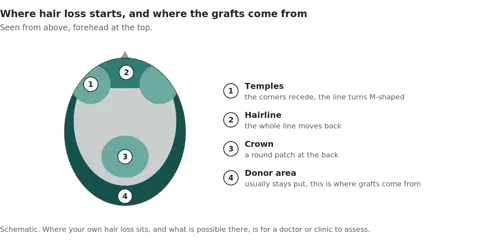
Below is what is possible for each area, in short, with a link to where it is covered properly. In every case the follicles come from the band around the back and sides of your head, which in inherited hair loss usually stays put.
Can you have a hair transplant on the crown?
The crown can be treated perfectly well, but it takes more grafts than the hairline does for the same visible result, usually 1,500 to 2,500. It is a round surface where the hair grows in a whorl, so the coverage has to be spread across a wider area and the eye reads any gap in it quickly.
A crown that is still spreading will keep spreading after surgery, which is why planning matters more here than anywhere else. Ask a clinic how it handles that, not only what it charges. Fill the whole patch now and a ring can open around it in a few years.
Hair loss at the temples
The temples are where a hair transplant works most predictably. It is a defined area, it borders hair that stays put, and it is the part of your head where the difference shows most. Clinics treat this more often than anything else, and usually with fewer grafts than a full hairline or a crown.
For a small correction at the corners it takes less again. What that means in grafts and in money is in our guide to how many grafts you need.
A hairline that keeps moving back
A hairline receding across its full width needs more surface than the corners alone, and so more grafts. The result is straightforward to plan because the line is even, but the question of when weighs heaviest here: if the line is still actively moving, it will carry on doing so after surgery.
Which technique a clinic proposes for a hairline varies, and that affects how much gets shaved. What separates FUE, DHI and sapphire FUE is in FUE vs DHI vs sapphire FUE.
Diffuse thinning across the whole top
Diffuse thinning across the whole top is the pattern where a transplant is least often the right answer. If the entire head is thinning, the donor area may be affected too, and then you are moving hair that will also disappear in time. Harvard Health states that not everyone with this pattern is a good candidate, and that it is generally a poor fit where loss is widespread.
This is also the usual pattern in women. What that means is covered in our guide to hair transplants for women.
Thinning at the back or the sides
Thinning at the back and sides does not fit the ordinary inherited pattern, because that is precisely where hair tends to stay. That band is the donor area, so if it is thinning the whole calculation changes. Have a doctor look at it before you start requesting quotes: a clinic cannot read this from a photograph and neither can we.
How many grafts does each area take?
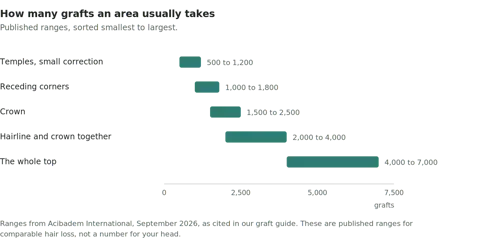
How many follicles an area takes varies widely, from a small correction at the temples to the whole top of the head. Below are the ranges clinics publish for comparable hair loss.
Area | Grafts | Predictability | What it turns on |
|---|---|---|---|
Temples, small correction | 500 to 1,200 | High | Small, well-defined area |
Receding corners | 1,000 to 1,800 | High | Borders hair that stays put |
Crown | 1,500 to 2,500 | Medium | Round surface, may keep spreading |
Hairline and crown together | 2,000 to 4,000 | Medium | Whether the hairline is still moving |
The whole top | 4,000 to 7,000 | Low | Whether your donor supply can carry it |
Scroll sideways for all columns →
Ranges from Acibadem International, September 2026, as cited in our graft guide. These are published ranges for comparable hair loss, not a number for your head.
Why so many people end up in Turkey for this
Turkey is Europe's largest destination for hair transplants, and the price is only part of it. Istanbul has hundreds of clinics that do almost nothing else, so the teams there run very high volumes year after year. That specialisation is why plenty of people who do not need the trip for the money go anyway.
Then there is how it is organised. At most Turkish clinics it comes as a package: a private transfer from the airport, nights in a three to five star hotel included in the price, a coordinator who speaks your language, and the aftercare built in. A lot of the clinics look more like hotels inside than hospitals.
That is the part a bare price comparison loses. At home you buy the procedure and arrange everything else yourself. In Turkey that whole layer is included, and you still pay less than you would for the surgery alone back home. The figures are in our guide to what a hair transplant in Turkey costs.
More clinics are also working partially or entirely without shaving, which removes the biggest practical objection for a lot of people.
One procedure, or more than one?
A hair transplant is rarely a single operation that closes the subject for good, and that is normal rather than a warning. The transplanted hair stays, but the hair around it can keep thinning. Wayne Rooney announced his in 2011; James Nesbitt has had more than one over several years and went public with the second as well.
Two practical things follow. You are not locking in your whole future with one procedure. And a clinic that plans your donor supply across more than one round, instead of spending all of it at once, is thinking past this invoice. To see what clinics would propose for your area, you can request up to six quotes in one go with no obligation.
Frequently asked questions
Is a crown hair transplant harder than the hairline?
The crown takes more grafts than the hairline for the same visible effect, usually 1,500 to 2,500, because it is a round surface where the hair grows in a whorl. A crown that is still spreading also carries on spreading after surgery. It can be treated perfectly well, but ask a clinic how it plans around that rather than only what it costs.
Can you have a hair transplant on the temples only?
A transplant on the temples alone is very common and usually takes 1,000 to 1,800 grafts, fewer than a full hairline or a crown. It is a defined area next to hair that stays put, which makes the outcome easier to predict. How many grafts you would need depends on how far the corners have receded and is for the clinic to assess at consultation.
Does a hair transplant work for diffuse thinning?
For diffuse thinning across the whole top, a transplant is often not the best option. Harvard Health states that not everyone with this pattern is a good candidate and that it is generally a poor fit where loss is widespread, because the donor area may be affected as well.
Does a hair transplant stop hair loss?
A hair transplant does not stop hair loss. The transplanted hair stays, but the hair around it can keep thinning, which is why many people have a second procedure years later. That is expected rather than a sign that something went wrong.
What does a hair transplant for the temples cost?
Treating the temples alone is usually the least expensive option, because it needs fewer grafts than a full hairline or a crown. At smaller graft counts the rate per graft is typically higher, since the fixed cost of a surgical day is spread across fewer follicles.
Before you decide
This article gives general information and is not medical advice. What is causing your hair loss, and whether treatment suits it, is for a doctor who examines your scalp to judge. Get that done before you pay a deposit. Our terms are set out in the patient terms and medical disclaimer.