
Hair transplants for women: what differs, and when it isn’t the answer
Turkish clinics treat women, often without shaving. But not every woman is a good candidate, and that is the part clinic websites tend to leave out.
On this page · 10 sections
Can women have a hair transplant?
Yes, Turkish clinics treat women, and several run a separate clinic or team for it. They quote the same way they do for men, per graft, and the technique is the same. What happens more often than with men is that little or none of the head is shaved.
But whether it can be done is not the same question as whether it is sensible for you, and for women the gap between those two is wider. Female hair loss is usually diffuse across the top of the scalp rather than a receding hairline, and that affects the exact area the donor hair has to come from.
Harvard Health puts it plainly: "Not everyone with female pattern hair loss is a good candidate for hair transplantation." Where loss is widespread and severe, it is generally a poor fit. That sentence is missing from most clinic websites, and it is the reason this guide exists.
Why hair loss in women follows a different pattern
Female hair loss usually starts at the parting and spreads outwards across the top of the head. The British Association of Dermatologists describes "diffuse thinning of the hair, mainly over the top of the scalp", with the parting becoming more visible. On the hairline it is explicit: "The hairline at the front of the scalp often remains normal."
Harvard Health reaches the same conclusion: "A woman's hairline rarely recedes, and women rarely become bald." In men the hairline retreats at the temples and a bald patch opens at the crown, while the band of hair around the back and sides stays put. That band is the donor area.
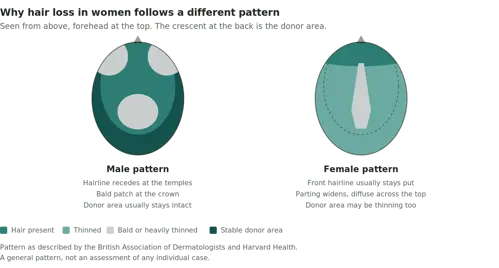
That is the crux of it. A transplant moves hair, it does not create any. If your donor area is thinning as well, you are moving hair that may also disappear in time, and you are spending donor supply you cannot replace.
How common is hair loss in women?
Hair loss in women is far more common than the street suggests. According to Harvard Health, about one in three women experiences hair loss at some point, and up to two-thirds of post-menopausal women have thinning or bald spots.
So rarely hearing anyone mention it is not evidence that it is rare. It is evidence that nobody talks about it.
What a doctor should rule out first
Hair loss in women has a cause other than the inherited pattern more often than it does in men, and several of those causes are treatable without surgery. Harvard Health names medical conditions, medications and physical or emotional stress as things to rule out before settling on the diagnosis, with blood tests for thyroid disorders and iron deficiency.
What gets checked | Why | What it means if this is the cause |
|---|---|---|
Thyroid | Blood test, named by Harvard Health | Treatable, surgery is not the answer |
Iron deficiency | Blood test, named by Harvard Health | Treatable |
Medication | Certain drugs cause hair loss | Possibly reversible, discuss with your doctor |
Physical or emotional stress | Can cause substantial temporary shedding | Often temporary, so waiting is wiser |
Raised androgens | The British Association of Dermatologists names PCOS, with acne, increased facial hair and irregular periods as signs | The underlying condition is treated first |
Scroll sideways for all columns →
Sources: Harvard Health and the British Association of Dermatologists, checked 21 October 2026. Which investigations you need is for a doctor to decide.
From which follows the sharpest question you can put to a clinic. If someone sends you a graft count and a price from a few photographs, without asking anything about your blood results, your medication, your cycle or when it started, then that party has ruled out none of the above. That is not a medical opinion. That is a quote.
Do you have to shave your head?
Shaving is usually the biggest objection for women, and Turkish clinics increasingly accommodate it. Many will shave partially or not at all, sometimes only a small strip in the donor area that then disappears under the surrounding hair.
It is not a more expensive package, it is a different way of working. Whether it is possible for you depends on your hair, your scalp and the number of grafts, which the clinic assesses at consultation. Ask explicitly before you commit, because not every clinic offers it, and ask exactly how much would be shaved.
Can you have a hair transplant on afro or curly hair?
Afro-textured and tightly curled hair calls for a clinic with experience in it, because the curl continues below the skin as well. That makes removing a follicle without damaging it more delicate work than it is with straight hair. Some clinics have a great deal of experience here and say so openly, others do not mention it at all.
We make no judgement about which clinic is better at it, because that is a judgement about surgical skill and we do not assess that. What you can do yourself: ask a clinic directly how many patients with your hair type they treat, and ask to see work on hair that looks like yours. A clinic that stays vague about that has answered the question.
What does a hair transplant for a woman cost?
A hair transplant for a woman costs the same as it does for a man, because clinics charge per graft and there is no separate rate for women. What the figures are in Turkey, and what a package does and does not include, is set out in our guide to hair transplant costs in Turkey and in the explanation of cost per graft.
One thing that comes up more often with women: because the front hairline usually stays put, the work sometimes involves fewer grafts than it would for a man with a receding hairline. At small graft counts the rate per graft is typically higher, because the fixed cost of a surgical day is spread across fewer follicles.
For readers in the UK there is a second reason cost comes up early. The British Association of Dermatologists states that "Surgical treatment is not offered under the NHS. This can be sought privately." So there is no domestic route that removes the price question, which is a large part of why British women end up comparing private clinics at home against clinics abroad in the first place.
What to ask a clinic before you pay anything
Is my donor area itself stable, and what are you basing that on?
What investigations should have been done before you comment on this?
How much gets shaved, and can it be done without?
How many women with my hair type do you treat in a year?
What happens if my hair loss simply continues afterwards?
That last one matters most. A transplant does not stop hair loss, so if the hair around the transplanted zone keeps thinning, the result can look different a few years on than it did on the day it was finished.
HairLinQ is free for patients and paid for by the clinics that receive patients through us. What we check about a clinic is that it holds a valid Turkish government authorisation for international health tourism, and nothing about surgical skill or outcome. That is set out in our clinic verification methodology, which is not a warranty of quality, safety or results.
If you want to see what clinics propose for your situation, you can request up to six quotes in one go and compare the proposals side by side.
Frequently asked questions
Do hair transplants work as well for women as for men?
Hair transplants do not automatically work as well for women, and the reason is the pattern of the loss. Harvard Health states that not everyone with female pattern hair loss is a good candidate, and that it is generally a poor fit where loss is widespread and severe. For women with a well-defined area and a stable donor area the picture is different. Only a doctor examining your scalp can tell those apart.
Does my hair have to be shaved off?
Your hair does not always have to come off. A growing number of Turkish clinics work on women without shaving, or shave only a small strip in the donor area that disappears under the surrounding hair. Whether it works in your case depends on your hair, your scalp and the number of grafts. Ask in advance, because not every clinic offers it.
Is hair loss in women rare?
Hair loss in women is not rare. Harvard Health reports that about one in three women experiences it at some point, and that up to two-thirds of post-menopausal women have thinning or bald spots. How little it gets discussed says nothing about how often it happens.
Can afro or curly hair be transplanted?
Afro-textured and curly hair can be transplanted, but it is more delicate work because the curl continues beneath the skin, so removing a follicle intact is harder than with straight hair. Ask a clinic how many patients with your hair type it treats each year and ask to see examples, rather than relying on a general claim of experience.
Should I see a doctor before requesting a quote?
Seeing a doctor first matters more for women than it does for men. Harvard Health names thyroid disorders, iron deficiency, medication and stress as causes to rule out before assuming inherited hair loss, and all of those are treatable without surgery. A clinic quoting a price with none of that established has not been able to take any of it into account.
Before you decide
This article gives general information and is not medical advice. What is causing your hair loss, and whether a transplant suits it, can only be judged by a doctor who examines your scalp and knows what your blood tests show. Go and get that done before you pay a deposit, even if you already know which clinic you want. Our terms are set out in the patient terms and medical disclaimer.